




























November 20, 2026
Dcorra
November 20, 2026
,
Dcorra
How High to Hang Wall Sconces in Every Room
Quick answer: Mount most wall sconces so the center of the light sits 60–66 in (152–168 cm) above the floor, which is roughly standing eye level. Go a little higher, 66–70 in (168–178 cm), in hallways and living rooms with tall ceilings, and lower, 48–60 in (122–152 cm), beside a bed so you can read sitting up. Beside a bathroom mirror, aim for about 60–66 in (152–168 cm), roughly at face height.
Wall sconces are the quiet heroes of a well-lit home. They light the walls, soften shadows that ceiling lights create and add a warm glow at eye level that makes a room feel lived in. They are also the light people most often hang at the wrong height, usually too high, because it is hard to picture a finished sconce from a bare wall and a junction box.
Below are the heights that work room by room, how to measure them, and the small details that separate a sconce that looks right from one that always looks slightly off.
The standard wall sconce height (and why it works)
The common starting point for a wall sconce is 60–66 in (152–168 cm) from the floor to the center of the fixture. That range sits close to the eye level of an adult standing in the room, so the light washes the wall evenly without shining into anyone's eyes and without throwing all of its glow at the ceiling.
Think of it as a default, not a law. The right height depends on three things:
- Your ceiling height. On ceilings above about 9 ft (2.7 m), sconces at 60 in (152 cm) can look like they are sinking. Nudge them up toward 66–72 in (168–183 cm).
- The shape of the sconce. A tall fixture reads differently from a compact one. What matters is where the light source and the visual middle of the fixture land, not just the mounting plate.
- What is around it. Mirrors, headboards, artwork, door frames and windows all set reference lines. A sconce should look connected to them.
How high to hang wall sconces, room by room
| Where | Center of sconce from floor |
|---|---|
| General / standard | 60–66 in (152–168 cm) |
| Next to a bed | 48–60 in (122–152 cm) |
| Living room | 60–70 in (152–178 cm) |
| Hallway and entry | 60–70 in (152–178 cm) |
| Beside a bathroom mirror | 60–66 in (152–168 cm) |
| Dining room | 60–66 in (152–168 cm) |
Next to the bed
"How high to hang wall sconces next to bed" is the first suggestion Google offers when you start typing this question, and for good reason: bedside sconces free up the nightstand and look tailored, but only if they are placed for the person in the bed.
The simplest method is physical. Sit up in bed against your pillows and have someone mark the wall a few inches above your shoulder. That mark is usually your height, typically somewhere between 48 and 60 in (122–152 cm) from the floor. If two people with different heights share the bed, split the difference or mark each side separately. Horizontally, center the sconce over the nightstand or place it just outside the edge of the mattress.
For reading, an adjustable head makes a big difference. The Swing Arm Linen Wall Lamp lets you pull the light toward a book and push it back when you are done, and the linen shade keeps the glow warm and diffused. If you prefer something more compact, the Adjustable Bedside Glass Wall Light is 11.8 in (30 cm) tall with a lamp holder that adjusts through 350 degrees, so you can aim it at the page or turn it for ambient light.
Renting, or not ready to call an electrician? Look for a plug-in model. The Rattan Swing Arm Wall Sconce is listed as plug-in, with a swing arm that projects 19.1 in (48.5 cm) from the wall. With a plug-in sconce, also plan where the cord will run down to the outlet.
Living room
Living room sconces are mostly about atmosphere and balance, so they can sit a little higher than bedside lights: 60–70 in (152–178 cm) to the center. When sconces flank a fireplace, a mirror or a large piece of art, place them in relation to that feature. Keep them symmetrical, roughly in line with its middle or a little above, and measure each one from the feature rather than trusting a long level line across a wall that may not be perfectly true.
Hallways and entries
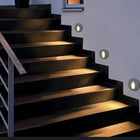
In a hallway, sconces wash the walls and guide you through the space. Mount them 60–70 in (152–178 cm) high and space them about 8–10 ft (2.4–3 m) apart for an even rhythm. In a narrow hall, choose a slim profile so nobody brushes against it. If your hallway leads to stairs, browse our stairs and entry lighting for low step lights that pair well with wall sconces.
Bathroom vanity
Beside a mirror, the goal is even light on your face, which means lighting from both sides at roughly face height. Mount side sconces about 60–66 in (152–168 cm) from the floor and about 36–40 in (91–102 cm) apart, center to center, or just outside the mirror frame. A tall glass sconce works especially well here. The Fluted Glass Cylinder Wall Sconce has a shade 11.8 in (30 cm) tall and comes as a single or a set of 2, so a matching pair for either side of the mirror is simple.
If there is no room on either side, a single bar light above the mirror is the alternative. Mount it a few inches above the top of the mirror and choose one somewhat narrower than the mirror itself. The Travertine Wood Vanity Light comes in 12.6 in (32 cm), 20.1 in (51 cm) and 27.6 in (70 cm) widths, so you can match it to a single or a double vanity.
One important note: anything mounted close to a shower or bath needs to be suitable for that location. Check the product page and follow your electrician's advice and local code for bathroom zones.
Dining room
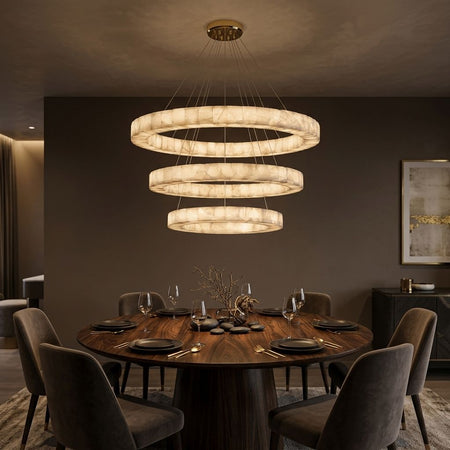
Sconces on either side of a sideboard or a large mirror add a soft second layer to the light over the table. Keep them near the standard 60–66 in (152–168 cm). Our guide to modern dining room lighting ideas shows how wall light, the main fixture and candles work together.
How to measure: center, box and fixture
Every height in this guide is measured from the finished floor to the center of the sconce. In practice, your electrician needs a slightly different number: the height of the junction box, which usually sits behind the mounting plate rather than at the center of the light.
- Decide where you want the center of the light.
- Check the product dimensions for the distance between the center of the backplate and the center of the fixture.
- Give your electrician the box height, adjusted by that difference.
Skipping step two is the most common reason a sconce ends up a few inches higher or lower than planned, especially with tall or downward-facing designs.
Spacing and clearance rules worth knowing
- Keep at least 6 in (15 cm) between a sconce and a door or window frame.
- In living rooms, sconces spaced about 6–8 ft (1.8–2.4 m) apart avoid both crowding and dark gaps.
- Sconces that stick out from the wall should stay clear of walkways and door swings.
- You should never look straight into a bare bulb from where you normally sit or stand. If you do, choose a shade that covers it or raise the fixture.
Choosing the right light for the job
Once the height is set, match the sconce to its role. Fabric and glass shades give soft ambient light for living rooms and halls. Adjustable and swing-arm designs are best for reading. Paired glass sconces flatter faces at a mirror. For a bedroom with a calm, natural feel, see our Japandi bedroom ideas for how linen and warm light work together.
Measure twice before you drill. Dcorra accepts returns within 30 days of delivery for unused items in their original packaging, but return shipping is paid by the customer, so it is worth checking dimensions on the product page first. When you are ready, explore all wall lights.
Through November 30, code BLACKFRIDAY takes 25% off at Dcorra.
Frequently asked questions
What is the standard height for a wall sconce?
The common standard is 60–66 in (152–168 cm) from the floor to the center of the fixture, about standing eye level. Adjust up on tall ceilings and down for bedside reading lights.
How high should a sconce be next to a bed?
Usually 48–60 in (122–152 cm) from the floor. Sit up in bed and mark a few inches above your shoulder. Center the sconce over the nightstand or just outside the mattress edge.
How far apart should vanity sconces be?
About 36–40 in (91–102 cm) apart, center to center, at roughly 60–66 in (152–168 cm) high, so light falls evenly on both sides of your face.
Do you measure sconce height to the top, bottom or center?
Measure to the center of the fixture. Then use the product dimensions to work out the junction box height for your electrician, because the box is often not at the fixture's center.
Can I install a wall sconce without hardwiring?
Yes, if you choose a plug-in sconce. Check the power source listed on the product page. Plug-in models need a nearby outlet and a tidy plan for the cord.